
Reviewed · OAHU
Surf Activity on the Wai Kai Wave in Ewa Beach
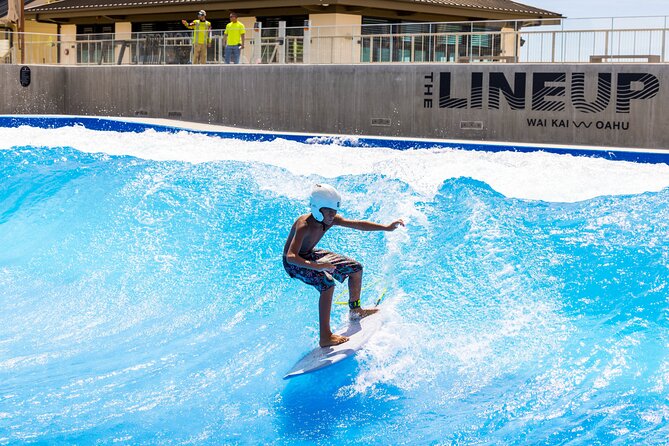
The clever idea here is simple: you surf a deep-water standing wave without paddling out or waiting for ocean waves. Set the soft-top board down, take your position, and let the moving water carry you forward. For a first attempt, that removes two of surfing’s hardest early skills.
I like the steady stream of waves, which lets you try again quickly after a fall. I also like the friendly coaching, including useful tips on finding the wave’s power zone. The main drawback is that this is not the same as surfing in the ocean. You’ll learn balance and board control, but not paddling, wave selection, or dealing with changing sea conditions.
Key Points Before You Book
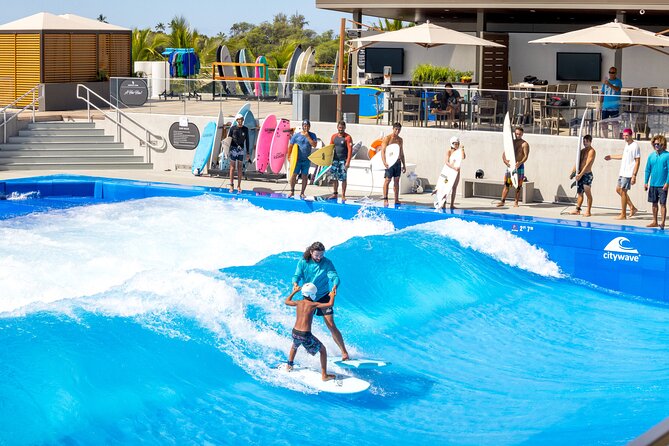
- No paddling required: You start from a fixed position on the Wai Kai Wave, making this much easier than learning in open water.
- Three wave lengths: Choose from 35-foot, 65-foot, or 100-foot options, with the 100-foot session lasting 30 minutes.
- One hour in total: The session includes a video orientation, demonstrations, instruction, and about 45 minutes on the wave for standard sessions.
- Small open group: Up to 10 people can book into the same coaching session, so you’ll share the wave area with others.
- Equipment is provided: Your session includes a soft-top surfboard and helmet.
- Good for first-timers and surfers: Beginners can learn the basics, while experienced surfers can work on balance, turns, and equipment control.
Why the Wai Kai Wave Works for Beginners
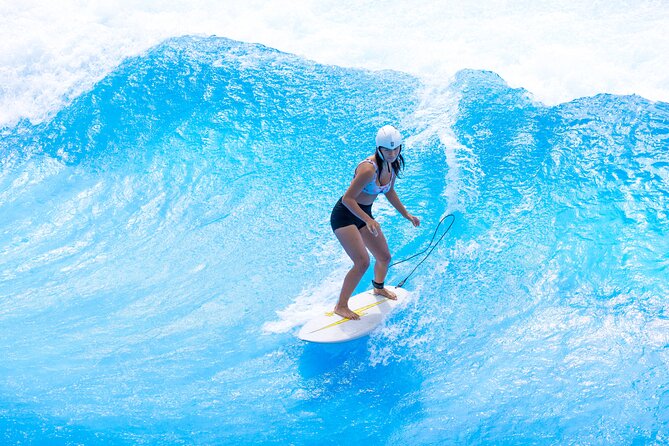
Learning to surf in the ocean usually begins with a lot of effort before the fun arrives. You paddle, miss waves, turn the board around, try to stand, and often end up back in the water before you have felt a clean ride. The Wai Kai Wave removes much of that early struggle.
At Wai Kai, you place the board on the wave, get into position, and ride the moving water. That means you can focus on the central skill of surfing: staying balanced while the board moves beneath you. You do not need a strong paddling stroke or a polished pop-up before you begin.
That setup is especially helpful for children and adults who are curious about surfing but uneasy about the ocean. The minimum age is 10, and most people can participate. You should still expect falls. The wave is easy to access, but standing and staying in the right part of the flow takes practice.
The first few attempts may feel less natural than expected. A standing wave has its own rhythm, and you need to find the area where the water gives the board enough power. Once that clicks, you can ride one wave after another instead of waiting several minutes for the next suitable ocean swell.
Other Oahu mornings and afternoons that pair well with this one:
- Oahu Grand Circle Island and Haleiwa Tour: 9-Hr Deluxe Experience
★ 5.0 · 17,387 reviews - Oahu: Grand Tour Around Island 16 Locations plus Snorkeling
★ 5.0 · 8,669 reviews - Parasailing Experience in Waikiki, HI
★ 5.0 · 7,692 reviews
What Happens During the One-Hour Session
Your session begins with a video orientation. This gives you the basic safety information and introduces the mechanics of the wave before you get on the board. A demonstration follows, showing how to begin your first ride and how to position yourself.
The instruction does not stop once the session starts. Coaches offer pointers as you practice, helping you adjust your stance and find the wave’s power zone. That ongoing help matters because the first attempt can feel confusing. You may understand the instructions on land, then need a small correction once the board starts moving.
A standard session lasts about one hour. About 45 minutes are spent on the Wai Kai Wave, with the remaining time used for orientation and instruction. That is a useful amount of active time for a first lesson, though it can pass quickly once you begin riding.
This is an open group coaching session, with a maximum of 10 people. You will not receive a private instructor for the full hour. The tradeoff is that you get a social setting and access to group guidance at a lower price than a private lesson would usually command. If you need constant one-on-one attention, ask yourself if a shared session fits your learning style.
The experience includes a soft-top surfboard and helmet. The soft board is a sensible choice for beginners because it is designed for instruction and feels less intimidating than a hard board. The helmet is part of the supplied equipment, so you do not need to arrange those items yourself.
Choosing Between the 35, 65, and 100-Foot Waves
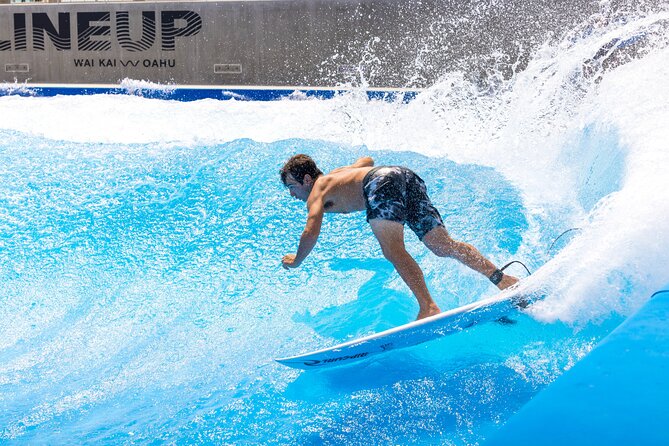
You can choose a 35-foot, 65-foot, or 100-foot wave. The longer options give you more room to work on your ride, but a longer wave is not automatically better for a beginner. More distance can also mean more time to lose your balance.
The 35-foot option makes sense if you are completely new, nervous about the speed, or mainly want to understand how the wave works. It gives you a manageable introduction without committing to the longest ride.
The 65-foot wave offers a middle ground. It should appeal to you if you have some board-sport experience or if you find your balance quickly during the first part of the session. You have more space to practice while still keeping the experience fairly contained.
The 100-foot option is the longest and most demanding choice. The available information specifies that a 100-foot session lasts 30 minutes, rather than the standard 45 minutes on the wave. That shorter time may suit an experienced surfer who wants concentrated practice, but it is worth noting before you book.
The 100-foot wave is also offered only on the last Friday of each month from 3 p.m. to 5:30 p.m., during the stated April through August 2025 period. If that option is important to you, check the date and time carefully before paying.
The Difference Between a Wave Pool and Ocean Surfing
I would treat Wai Kai as a training ground and a fun water activity, not a complete substitute for ocean surfing. The wave gives you repeated practice with stance, weight shifts, board direction, and balance. Those skills can help you feel less awkward when you later try the sea.
Still, the setup removes several parts of real surfing. You do not paddle into a wave, read a lineup, turn around at the right moment, or judge a breaking wave. Ocean water also changes from one wave to the next. The Wai Kai Wave is more controlled and predictable.
That difference is not a flaw. It is the reason the experience works so well for beginners. You can focus on one task at a time rather than trying to solve every surfing problem on your first day.
It also makes the activity useful for experienced surfers. You can repeat the same motion many times and work on a turn or stance without waiting for suitable conditions. One account of the experience described using the wave to improve surfing and dial in equipment. That is a good way to think about it: controlled practice when ocean conditions are flat or inconvenient.
Same island, a completely different kind of day:
- Salute to Pearl Harbor Including USS Arizona
★ 4.5 · 7,433 reviews - Majestic Circle Island Tour with Lunch
★ 5.0 · 7,014 reviews - Oahu’s Ultimate Tour: Dole, Turtle Snorkel, Pali Lookout & More
★ 4.5 · 5,461 reviews - Oahu Circle Island Tour with Turtle Snorkeling— Small-Groups
★ 5.0 · 5,214 reviews
How Much Fun Is It After You Learn to Stand?
The learning curve appears to be quick for some people, but do not expect to surf perfectly from the first attempt. The staff can help you get started, yet balance remains your job. You may fall several times before you understand where the board needs to sit in the moving water.
Once you find that position, the activity becomes more than a basic lesson. You can ride wave after wave, adjust your stance, and try to stay in the strongest part of the flow. That repeatability is the main source of the fun.
The session also works for mixed groups. A first-timer can learn the basics while a stronger surfer practices tricks nearby. You may see riders making advanced moves, which can be encouraging or slightly humbling. I would use those skilled surfers as inspiration, not as a standard you need to match.
The open format creates a lively learning environment, but it also means the pace may vary. Some people will be falling and restarting, while others are already comfortable. The coaches need to give useful advice across the group. The maximum of 10 people keeps the group from becoming huge, though it is still not a private lesson.
Coaching, Staff, and the Waterman Setting
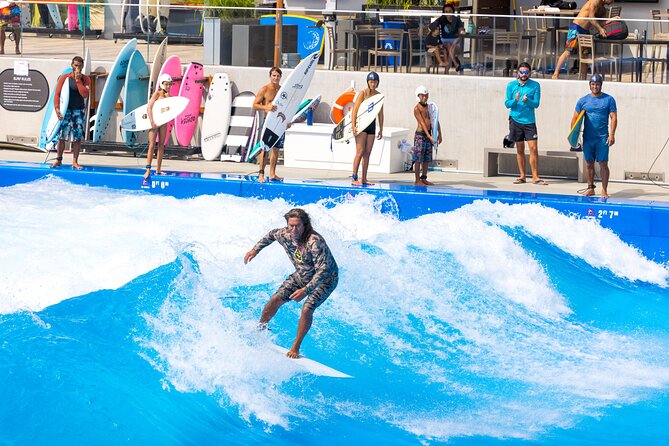
The coaching is one of the strongest reasons to book instead of simply trying to figure out the wave alone. You receive a video briefing, a demonstration, and pointers during the ride. The most useful advice is likely to come after your first few attempts, when a coach can see exactly where your balance is breaking down.
The venue also connects the surfing session with a broader water-focused setting. The LineUp at Wai Kai includes access to a lagoon area, food, shopping, and other activities nearby. That makes it possible to turn a one-hour surf session into part of a longer outing at Wai Kai rather than making the trip for one short activity alone.
A professional surfer named Kekoa Cazimero has also been associated with a surf experience at the venue. Do not assume that every open session includes personal coaching from him, but his involvement shows the type of surfing culture connected with the facility. If meeting or learning from a specific surfer is important to you, confirm that separately before booking.
The staff’s tone appears geared toward encouragement rather than pressure. That matters when you are falling in front of other people. You need clear corrections, but you also need enough patience to try again without feeling that every mistake is a problem.
Price and Practical Value at $68.06
At $68.06 per person, this is not a cheap way to spend an hour in the water. The value depends on what you want from the activity.
For a complete beginner, the price covers the board, helmet, orientation, demonstration, and instruction. You also receive about 45 minutes of active wave time in a setting where you can make repeated attempts. Compared with paying for a traditional ocean lesson and spending much of the time paddling or waiting, that repeated practice has real value.
For an experienced surfer, the price is easier to justify if you plan to use the wave for focused practice. You can work on balance and technique even when ocean conditions are flat. If you are only looking for a single novelty ride, the cost may feel high after the excitement of the first few attempts fades.
The session is best value when you treat it as both instruction and practice. I would not book it expecting a full day of surfing. I would book it as a concentrated hour, then add time at the wider Wai Kai facility if you want food, lagoon time, or more activities.
The average booking lead time is about 20 days. That suggests you should plan ahead, especially if your Oahu dates are fixed. Mobile tickets make arrival simpler, and confirmation is provided at booking.
Who Should Book This Oahu Surf Activity?
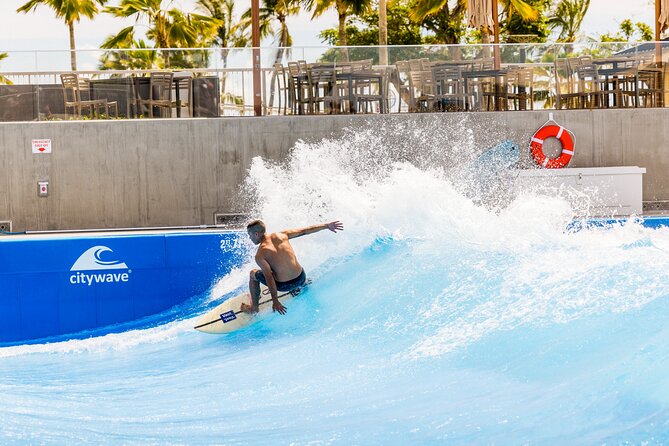
This is a strong choice for you if you have always wanted to try surfing but do not want your first lesson to involve open-ocean uncertainty. It also fits families with children age 10 or older, groups with mixed ability, and surfers who want repeated technique practice.
I would be more cautious if you want a quiet private lesson, a natural beach setting, or a full introduction to ocean safety and wave reading. The group format and controlled wave are central to the experience, not minor details.
You should also be comfortable with the phrase use at your own risk. The activity requires good weather, and poor weather can lead to a date change or full refund. Service animals are allowed, and the site is near public transportation.
Free cancellation is available up to 24 hours before the start time. Within 24 hours, the payment is not refunded, and changes are not accepted. That is a fair policy, but you should avoid booking the session before your Oahu plans are reasonably firm.
Should You Book the Wai Kai Wave?
Book it if you want a friendly, repeatable introduction to standing on a surfboard without paddling. The supplied equipment, coaching, small group size, and steady wave make this one of the more approachable ways to try surfing on Oahu.
Choose the 35-foot option if you are nervous or completely new. Consider the 65-foot wave once you feel balanced, and check the special schedule carefully if you want the 100-foot session. I would also leave time to enjoy the lagoon, food, and other parts of Wai Kai, since the surf session itself lasts only about an hour.
Skip it if your main goal is to learn real ocean surfing from start to finish. For everyone else, especially first-timers and surfers looking for controlled practice, the Wai Kai Wave offers a useful mix of instruction, repetition, and plain fun.
FAQ
Where does the Wai Kai Wave surf activity take place?
The activity starts at 91-1621 Keoneula Boulevard, Ewa Beach, Hawaii 96706. It ends back at the same meeting point.
How long does the activity last?
The full standard session lasts about one hour. It includes orientation, demonstrations, instruction, and about 45 minutes on the Wai Kai Wave.
Do I need previous surfing experience?
No. The activity is designed for beginners, and no previous surfing experience is required.
Do I need to know how to paddle?
No. The Wai Kai Wave allows you to set the board down, get into position, and ride the moving water without paddling into the wave.
What equipment is included?
The session includes a soft-top surfboard and helmet.
How old must participants be?
Participants must be at least 10 years old.
How many people can join a session?
The open group coaching session has a maximum of 10 people.
What wave lengths are available?
You can choose a 35-foot, 65-foot, or 100-foot wave. The 100-foot session lasts 30 minutes.
What is the cancellation policy?
You can cancel at least 24 hours before the start time for a full refund. Cancellations or changes made less than 24 hours before the start time are not accepted, and the payment is not refunded. If poor weather causes the activity to be canceled, you will be offered another date or a full refund.
Newest Oahu write-ups
- West Oahu: Eco-Friendly Whale Watching Cruise★ 4.5 · 40 reviews
- Oahu: Waikiki Eco-Friendly Morning Whale Watching Cruise★ 4.4 · 119 reviews
- Oahu: Circle Island Tour with Lunch & Waimea Waterfall★ 4.4 · 134 reviews
- West O’ahu: Dolphin Watching and Snorkeling Catamaran Cruise★ 4.5 · 31 reviews
- West O’ahu: Swim with Dolphins Catamaran Cruise★ 4.9 · 70 reviews
- Oahu: Waimea Falls & valley & North Shore day★ 5.0 · 4 reviews
- Honolulu, Oahu: Waikiki Turtle Snorkel Tour w/Shuttle Option★ 3.6 · 81 reviews
- Waikiki: Surf Lessons Easy 60 min classes no crowds!★ 4.9 · 21 reviews