
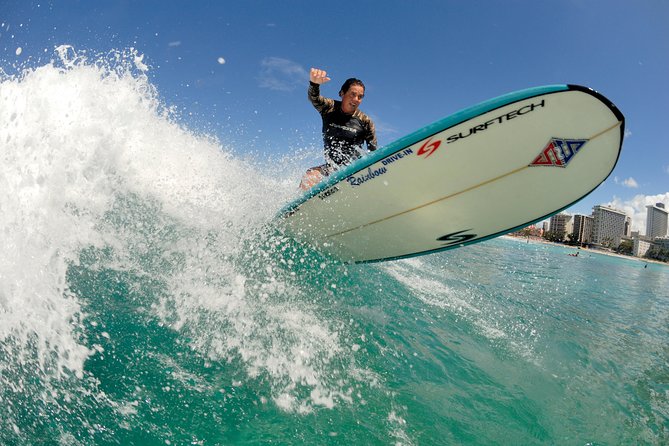
Reviewed · OAHU SURF LESSONS
North Shore Beginner Surf Lesson, Hawaii
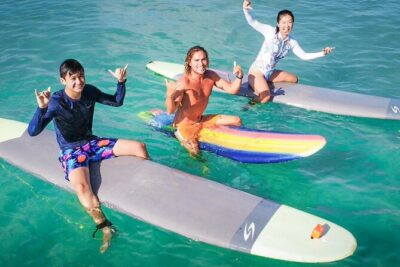
The North Shore is famous for serious surf, but this lesson aims at the gentler side of the sport. In two hours, you’ll learn safe falling, ocean rules, paddling, wave timing, and the quick move from belly to feet. The small group, capped at four people, gives your instructor time to help you catch waves instead of leaving you to guess.
I like the clear land lesson and the personal coaching in the water. Instructors such as Henry, Travis, Tanner, Eric, and Mark have helped first-timers stand up and ride, often several times. I also like that the board and other needed surf gear are included. The main catch is practical: you must swim, drive yourself from Surf N Sea to the surf spot, and accept that weather or ocean conditions can cancel the lesson.
Key points to know before you book
- Small groups matter: The lesson has a maximum of four people, so you get more hands-on help with paddling, wave choice, and standing.
- The lesson starts on land: You practice safe falling, ocean etiquette, board choice, and the move from lying down to standing before entering the water.
- You drive to the beach: Meet at Surf N Sea in Haleiwa, then provide your own transport to the surf location.
- The best results come with calm expectations: Many beginners stand up, but surfing still takes balance, timing, and effort.
- Children under 13 need a private lesson: Group lessons are for ages 13 and older.
- Weather can change the plan: Poor conditions may lead to a new date or a full refund.
Why this North Shore lesson works for first-timers
Surfing can look easy from shore. You lie on a board, catch a wave, stand up, and glide. In practice, the timing is fussy, the board moves under you, and paddling takes more work than most people expect.
This lesson breaks the process into useful pieces. First, you learn on land. Then you practice the pop-up, the quick movement from your stomach to your feet. You also learn how to fall safely, which sounds basic but helps you relax once the board starts moving.
The instructors also explain ocean etiquette. That matters on the North Shore, where surfing is not just a tourist activity but a major part of local beach culture. Learning where to sit, how to avoid other surfers, and how to choose a suitable wave gives you skills that remain useful after the lesson ends.
The format suits a complete beginner, an older child who meets the age requirement, or an adult who has always wanted to try but never found a sensible starting point. You do not need to arrive knowing how to surf. You do need to be comfortable swimming in the ocean and ready for a physical session.
More Surf Lessons in the North Shore
- Surf Lessons on the North Shore of Oahu
★ 5.0 · 267 reviews - Private Surfing Lessons on the North Shore of Oahu
★ 5.0 · 87 reviews - North Shore Surfing Lessons Oahu Hawaii
★ 4.5 · 68 reviews
Meeting at Surf N Sea in Haleiwa
The lesson begins at Surf N Sea, at 62-595 Kamehameha Highway in Haleiwa. This is the important location to enter into your navigation app. The activity ends back at the same meeting point.
There is no transportation provided. After checking in, you drive from Surf N Sea to the beach used for the lesson. Build in extra time for the drive and parking, and do not treat the meeting time as a loose suggestion. One family lost time after getting turned around and arrived 20 minutes late. The staff helped them find the right place, but arriving late can shorten your water time.
The start point in Haleiwa is useful if you are already spending part of the day on the North Shore. It also makes this lesson easy to pair with a visit to Haleiwa before or after surfing. Just remember that the lesson itself is not a hotel pickup and does not include a shuttle.
Morning and afternoon times are available. Choose the session that fits your day, but allow enough time for driving and changing. You should also avoid placing a tight reservation immediately afterward. Ocean activities can run on a less exact clock than a museum visit.
What happens during the two-hour lesson
The first part takes place on land. Your instructor explains the basic rules and shows you how to handle the board. You learn how to fall without fighting the board, how to get from lying down to standing, and how to position yourself for a wave.
You also discuss the best type of board for a beginner. The lesson includes a surfboard and the other equipment needed for the activity. The supplied reviews point to foam boards as part of the beginner setup, and one useful tip is to wear a rash guard or wet shirt because the board can rub your skin.
Once you understand the basics, you head into the water. Your instructor helps you paddle out, watches for suitable waves, and gives instructions as you go. This is where the four-person limit pays off. A small group still means you may share time while other people catch waves, but you should receive more direct help than in a large class.
The instructor’s job is not just to push you onto any wave. You learn what a rideable wave looks like, when to paddle, and how to stand at the right moment. Several first-timers have managed to stand up more than once, and some have ridden waves all the way in. That is a realistic goal for a good day, not a guarantee.
The lesson lasts about two hours. That sounds generous until you add the land briefing, walking or paddling into position, waiting for waves, and taking turns. You will get genuine practice, but this is an introduction, not a full surf school course.
Waialua Bay and the beginner-friendly North Shore
Waialua Bay is listed as a stop on the experience. Its role here is practical: it offers a North Shore setting where beginners can work on the basics under instruction. The precise surf location can depend on conditions, so you should not assume that every session uses exactly the same patch of water.
The North Shore name can create the wrong expectation. In winter, parts of this coast are known for powerful surf, but a beginner lesson needs conditions that match the group. Your instructor chooses a suitable place and may adjust the plan for safety. That is one reason the weather policy matters.
You may spend more time waiting for a wave than you expect. That is normal. The instructor uses those pauses to talk about timing, wave shape, and technique. The lesson is not simply a series of attempts. It is a short introduction to how surfers read the ocean.
The bay setting also gives you the feeling of learning in a genuine surf area rather than in a swimming pool or artificial attraction. You are still receiving a structured class, but the ocean sets the pace. If conditions are less than ideal, you may catch fewer waves. One person found the lesson enjoyable even when the conditions were not perfect, which is a useful reminder to judge the session by the teaching as well as the number of rides.
More surf lessons in Oahu:
- Open Group Surfing Lesson in Waikiki, Hawaii
★ 4.5 · 582 reviews - Oahu: Beginner-Friendly Waikiki Beach Surfing Lesson
★ 4.9 · 425 reviews - Surfing Lessons On Waikiki Beach
★ 4.5 · 317 reviews - Waikiki Private Group Surf Lesson
★ 5.0 · 298 reviews
Haleiwa adds more than a meeting point
Haleiwa is both the starting point and one of the itinerary stops. It is the North Shore town connected with the lesson’s surf-shop base, so you can use the area to frame your day instead of treating the class as an isolated activity.
Give yourself time to find Surf N Sea and get organized before the lesson. Afterward, the activity returns to the meeting point. That makes Haleiwa a convenient place to continue your North Shore day, although this booking does not include transport or a separate town tour.
The practical value of Haleiwa is that you begin with a local surf outfitter rather than meeting an instructor at an unfamiliar beach with no preparation. You can ask questions at check-in, collect the needed equipment, and receive directions to the water.
Do not assume the listed stops mean you receive a guided sightseeing tour of both places. The focus is surfing. Waialua Bay and Haleiwa provide the setting and route for the lesson, while most of your two hours are devoted to learning in and around the water.
The instructors make the biggest difference
The strongest part of this lesson is the coaching. Henry is frequently singled out for patience, simple instructions, safety awareness, and help with catching waves. Other sessions have been led by Travis, Tanner, Eric, and Mark, with similarly positive comments about encouragement and clear teaching.
That does not mean you are guaranteed a particular instructor. It does show the qualities to look for in this kind of class. A beginner needs someone who can explain the same movement several ways, spot a manageable wave, and keep the group moving without making anyone feel rushed.
One instructor helped students understand surf etiquette, how waves break, and how to time the takeoff. Another gave steady help with paddling. Terrance was also noted for assisting tired people in the water. These details matter because the hard part is not only standing. Paddling back out can use a surprising amount of energy.
The instruction seems especially useful for adults who are nervous about being the least athletic person in the group. A 50-year-old first-timer had a positive introduction, and several families found that teenagers could stand up during their first session. You should still expect physical work. Surfing uses your arms, legs, stomach, and balance, and the lesson is not recommended for people with back or knee problems, recent surgery, or only moderate physical readiness.
What success looks like on your first lesson
A good first session does not require you to become a surfer in two hours. Success might mean standing up once. It might mean learning to fall correctly, catching a small wave on your knees, or leaving with a clear idea of what to practice next.
Many people have stood up during this lesson, sometimes on the second wave and sometimes several times. That is encouraging, but the ocean does not provide identical conditions for every class. Wave size, wind, timing, fitness, and comfort in the water all affect the result.
You will probably work harder than the activity description suggests. Paddling out, turning the board, waiting in the right place, and getting back on after a fall all take effort. One family found that teenagers learned quickly that surfing is not easy. That is not a flaw. It is part of understanding the sport.
The small group helps, but it does not remove the need to share waves and instructor attention. One person enjoyed the class but noted that a group lesson meant time had to be divided. A private lesson may be better if one child needs constant help, if your group has very different fitness levels, or if you want the most possible practice time.
Age, swimming, and fitness requirements
Group lessons are for children 13 and older. Children under 13 must take a private lesson. This rule is especially important on the North Shore, where even beginner conditions require attention to water safety.
You must know how to swim. The instructor may help you paddle and may assist when you are tired, but this is not a learn-to-swim class. You need to manage yourself in the ocean and remain calm if you fall from the board.
The activity is not recommended for people with back or knee problems or recent surgeries. A moderate level of physical fitness is expected. If you have concerns about your health, ask a medical professional before booking, since the lesson involves repeated paddling, getting on and off the board, and falling into the water.
Wear practical swim clothing. A wet shirt or rash guard is a smart choice because the board can rub against your chest and stomach. Bring the attitude that you may fall often, then treat each fall as part of the lesson rather than a bad result.
Is $104 a fair price?
At $104 per person, this is not the cheapest way to spend two hours in Hawaii. The price makes more sense if you value instruction rather than simply renting a board and trying on your own.
Your fee includes the surfboard and the equipment needed for the lesson. It also buys a land briefing, safety instruction, help choosing waves, and direct coaching in the water. With a maximum of four people, the cost is easier to justify than it would be for a large class where you spend most of the time waiting.
The value is strongest for a first-timer who wants a safe start and hopes to stand up during the session. It is weaker for an experienced surfer who already knows surf etiquette, board handling, and wave timing. In that case, a rental may fit your needs better, but this activity is specifically designed for beginners.
The rating is 4.7 from 114 reviews, with 93 percent recommending it. Those numbers fit the main pattern of the experience: strong teaching, friendly instructors, and a good chance of getting upright, balanced by the effort involved and the limits of a two-hour group session.
Weather, cancellations, and planning around the ocean
Surfing depends on conditions you cannot control. If poor weather makes the lesson unsafe, the provider may cancel it and offer another date or a full refund. That policy protects you, but it also means you should keep some flexibility in your North Shore plans.
You can cancel for a full refund up to 24 hours before the start time. Changes or cancellations inside that 24-hour window are not accepted for a refund. The cut-off uses local Hawaii time.
I would avoid booking this as the final, immovable activity before an evening flight. A weather change could shift your plan, and you need enough time to drive, check in, take the lesson, and return to Haleiwa. Book early if your schedule is tight, since the activity is often reserved about 17 days ahead.
Who should book this lesson?
This is a good fit for you if you are a first-time surfer, can swim, enjoy active outings, and want an instructor to explain the basics before putting you on a board. Families with teenagers, couples, solo visitors, and small groups of friends can all fit the format.
It is also a strong choice for an adult who has postponed surfing because the sport seems intimidating. The land briefing, safe-falling practice, and direct wave coaching give you a sensible first step.
Think twice if you cannot swim, have a recent surgery, or deal with back or knee trouble. You should also choose a private lesson for any child under 13. If you want a relaxed beach activity with no physical effort, this is the wrong pick. Surfing is fun, but it is work.
Should you book the North Shore Beginner Surf Lesson?
I would book it if standing on a board in the North Shore ocean is high on your Oahu wish list. The strongest reasons are the four-person maximum, the clear safety briefing, included equipment, and patient coaching from instructors such as Henry, Travis, Tanner, Eric, and Mark.
Book with realistic goals. You may stand up several times, or you may spend the session learning to paddle, balance, and fall safely. Bring a rash guard, arrive early at Surf N Sea, drive yourself to the water, and leave room in your day for weather changes.
For a genuine first taste of surfing, the $104 price is reasonable. Just remember what you are buying: two hours of guided practice, not mastery. That is enough to find out if you want to keep surfing, and for many people, that first successful ride is the highlight.
FAQ
Where does the surf lesson begin?
Meet at Surf N Sea, 62-595 Kamehameha Highway, Haleiwa, Hawaii 96712. The activity ends back at the meeting point.
Is transportation to the beach included?
No. You must drive from Surf N Sea to the surf spot. Private transportation is not included.
Do I need to know how to swim?
Yes. Participants must be able to swim before taking the lesson.
What equipment is provided?
The surfboard and all equipment needed for the lesson are included.
Can children under 13 join the group lesson?
No. Group lessons are for children 13 and older. Children under 13 require a private lesson.
What happens if bad weather cancels the lesson?
If poor weather causes a cancellation, you can be offered another date or a full refund. You can also cancel up to 24 hours before the start time for a full refund.
More North Shore days
- Oahu Grand Circle Island and Haleiwa Tour: 9-Hr Deluxe Experience
★ 5.0 · 17,387 reviews - Tour of North Shore & Waimea Waterfall
★ 5.0 · 3,682 reviews - Oahu’s North Shore: 8-Line Zipline Adventure
★ 5.0 · 3,616 reviews - Oahu North Shore Experience: Activities, Waterfall & Free Time
★ 5.0 · 1,799 reviews
Newest Oahu write-ups
- Private Surf Lessons in Honolulu★ 5.0 · 76 reviews
- Private Round-Trip Transfer: Honolulu International Airport to Hotel or Cruise Terminal★ 4.0 · 34 reviews
- Private Pearl Harbor USS Arizona Memorial★ 4.5 · 3 reviews
- Private Pearl Harbor and Mini Circle Island Tour from Waikiki★ 5.0 · 8 reviews
- Passport to Pearl Harbor “Private”★ 5.0 · 4 reviews
- Pearl Harbor USS Arizona and USS Missouri “Private”★ 5.0 · 10 reviews
- Private Tour Oahu – up to 6 passengers – Customizable★ 5.0 · 3 reviews
- Private One-way Airport Transfer Honolulu Airport To Honolulu★ 4.0 · 24 reviews
Oahu Surf Lessons, compared.
Beginner-Friendly Waikiki Beach Surfing Lesson
Read our review →
Family, Private & Group Surfing Lessons, Waikiki Courtesy Shuttle
Read our review →
Browse the lists this tour appears in