
Reviewed · OAHU SURF LESSONS
Private Surf Lesson
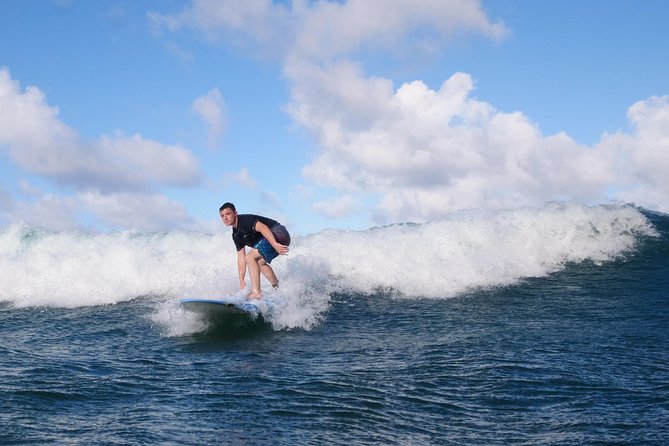
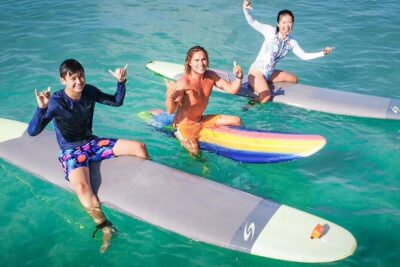
A private surf lesson on Oahu gives you something a group class cannot: an instructor focused on your small party and your exact ability. The lesson location is chosen after booking according to the ocean conditions, so you are not locked into one beach when the waves are better somewhere else. You may also see Hawaiian sea turtles while you practice.
I like the full two hours in the water, with boards and other equipment included, and I like the careful start with ocean safety and surfing basics. Instructors Mike, Andy, and Jon have worked with young children, complete beginners, intermediate surfers, and advanced students. The main drawback is the price: $225 per person is a serious spend, especially for a family, and the final beach location is not provided until after booking.
Key points at a glance
- The beach can change with the ocean: Your exact lesson location is provided after booking, based on the day’s water conditions.
- The lesson is fully private: Only your group takes part, so the instructor can adjust the pace and coaching.
- You get two hours and all equipment: The session includes a 10 to 15 minute land briefing followed by water time.
- Several instructors are named by past students: Mike, Andy, and Jon have taught children, first-timers, intermediate surfers, and advanced students.
- Safety is part of the instruction: Instructors are lifeguard and Red Cross CPR certified.
- Turtles may share the water: Hawaiian sea turtles are often seen during the lesson, though sightings are not guaranteed.
Why the changing beach matters on Oahu
The lesson begins at 53-360 Kamehameha Highway in Hauula, on Oahu’s North Shore. Yet that address does not necessarily mean you will spend the whole session at one fixed surf break. After you book, the instructor contacts you with the lesson location based on the ocean conditions for that day.
That flexibility is useful. Surfing depends on more than sunshine. Wave size, wind, currents, and the comfort level of the person learning all affect the right place to practice. A calm beach may suit a first-timer, while a more experienced surfer may need a spot with stronger or more useful waves.
You should plan your day with that change in mind. Do not assume the meeting address tells you exactly where you will enter the water. Wait for the instructor’s message and allow enough time to reach the confirmed site. The meeting point is also the end point listed for the activity, but the practical beach arrangement is guided by the conditions.
This approach is especially helpful for a private lesson. A large class often has to use one beach and one basic plan. Here, the instructor can make a better match between the water and your group. That does not guarantee perfect waves, but it gives the lesson a sensible chance of working with the day you actually get.
More surf lessons in Oahu:
- Open Group Surfing Lesson in Waikiki, Hawaii
★ 4.5 · 582 reviews - Oahu: Beginner-Friendly Waikiki Beach Surfing Lesson
★ 4.9 · 425 reviews - Surfing Lessons On Waikiki Beach
★ 4.5 · 317 reviews
Your first 10 to 15 minutes on land
You begin with a short meet and greet, followed by a 10 to 15 minute briefing on land. This may sound like time away from the waves, but it is one of the most useful parts of the session.
The instructor goes over surfing basics and ocean safety before you carry those lessons into the water. For a first-timer, that early explanation helps you understand what to do before a wave reaches you. It also gives you a chance to ask questions and settle any nerves.
The safety briefing matters because the ocean is not a swimming pool. Even a small wave can feel quick and powerful when you are standing on a board for the first time. Starting on land lets the instructor explain the plan before you have to think about balance, paddling, other people, and moving water at the same time.
If you already surf, this opening can be tailored to your needs. The lesson is not limited to basic standing practice. One student took private advanced lessons with Mike over several days and received specific feedback designed to improve technique and confidence. Another surfer used two sessions with Mike to work on progress from one day to the next.
The private format means you can tell the instructor what you want from the time. You may need a gentle introduction, help getting up consistently, advice on reading waves, or focused coaching on an existing skill. The lesson is still only two hours, so it helps to arrive ready to explain your experience and goals.
Two hours of coaching, not just a board rental
After the land briefing, you head into the water for the main part of the lesson. Your equipment is included, so you do not have to arrange a board separately. The point is instruction and practice, not simply being handed gear and sent toward the waves.
For beginners, the instructor can work on the basic sequence needed to catch a wave and stand. The exact pace will depend on the conditions and your comfort. You should expect active coaching, repeated attempts, and plenty of room to make mistakes safely.
That last part is important. Good surf instruction is not only about getting you upright once for a photograph. It is about helping you understand why a wave worked, why another did not, and what small change might help next time. Mike was praised for giving students useful advice while allowing them enough freedom to learn from safe mistakes.
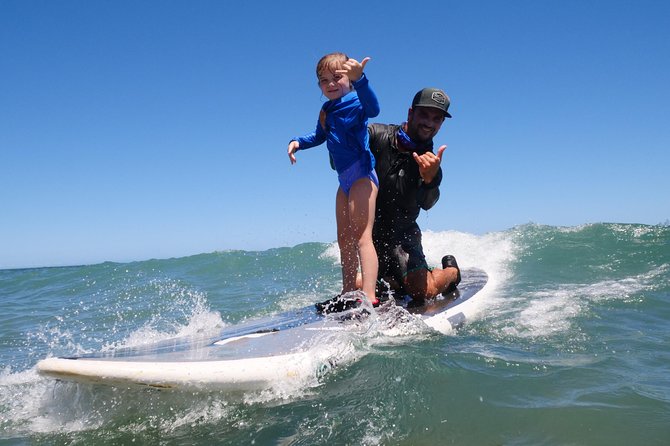
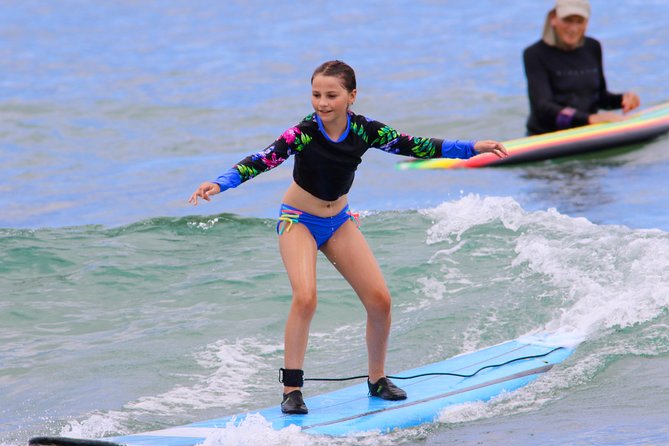
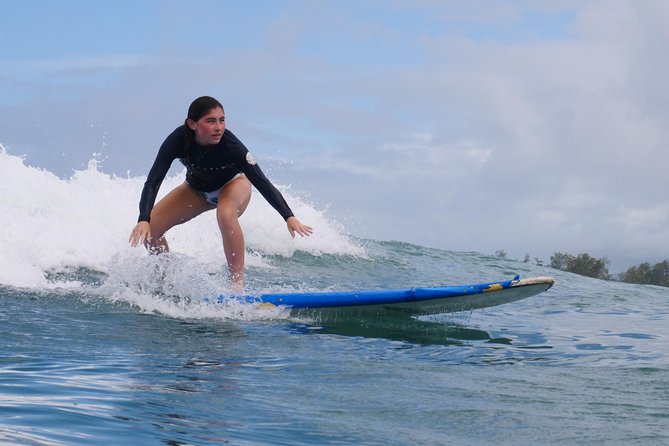
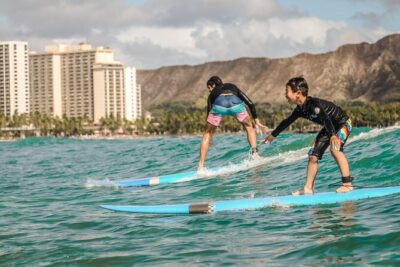
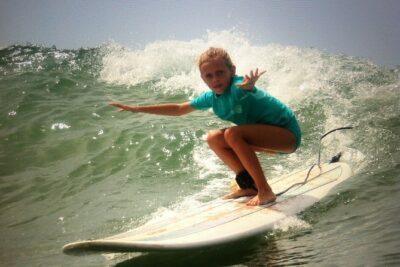
For children, patient teaching makes a large difference. Jon worked with a nine-year-old who gained confidence with each wave, while Andy taught a 13-year-old who reportedly surfed every wave during a private two-hour session. Those examples suggest that the instructors can keep young participants involved rather than giving all the attention to the adults.
Still, you should keep expectations realistic. Surfing is a physical skill, and no instructor can guarantee that every person will stand on every wave. Ocean conditions and individual balance both matter. The value here is having a trained person adjust the instruction as you improve instead of repeating one fixed lesson for everyone.
What the private format means for families
The activity is private, so only your group takes part. That is a strong fit for families, couples, and friends who want to learn together without being mixed into a large class.
A family of six managed to arrange a session with Mike on short notice during an open afternoon on the North Shore. The sons, ages 18, 16, and 14, were able to get on the boards soon after the initial call. A private group can make the lesson feel more personal, especially when participants have different ages or experience levels.
The format also lets the instructor shift attention as needed. A child may need simple instructions and extra encouragement, while an adult who has surfed before may want more technical advice. One instructor can work with different goals during the same booking, though a group of six will naturally mean less individual time per person than a group of two.
That is the main tradeoff. Private does not mean each member receives a personal instructor for the entire two hours. Your group shares the instructor. The benefit is that you are not sharing with strangers, and the lesson can be planned around your party’s pace.
The format suits groups that value privacy and flexibility more than the lowest possible cost. For a family splitting attention among several people, it can also be easier than trying to coordinate separate public classes.
Same island, a completely different kind of day:
- Oahu Grand Circle Island and Haleiwa Tour: 9-Hr Deluxe Experience
★ 5.0 · 17,387 reviews - Oahu: Grand Tour Around Island 16 Locations plus Snorkeling
★ 5.0 · 8,669 reviews - Parasailing Experience in Waikiki, HI
★ 5.0 · 7,692 reviews - Salute to Pearl Harbor Including USS Arizona
★ 4.5 · 7,433 reviews
Mike, Andy, and Jon bring different strengths
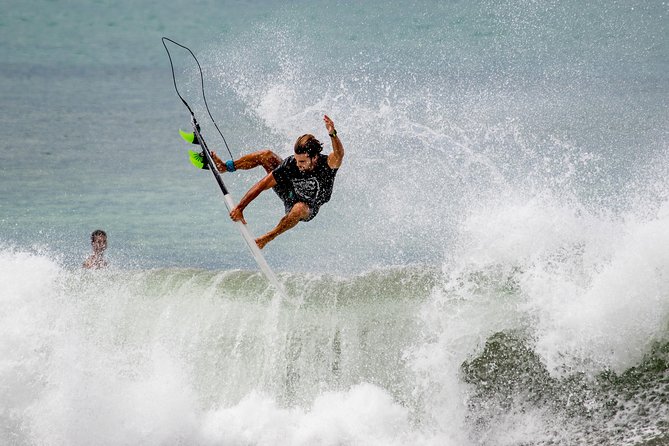
The instructors named in the available feedback include Mike, Andy, and Jon. Mike appears especially suited to students who want instruction adapted to their level. He has taught children, complete beginners, intermediate surfers, and advanced students, with coaching that ranges from first attempts to choosing better waves around Oahu.
One advanced student described Mike’s feedback as specific and useful without being overwhelming. That is a good quality to look for when you already know the basics but want to improve. Too little advice leaves you guessing. Too much can fill your head with corrections when you should be paying attention to the water.
Andy has worked with younger learners and with adults experiencing surfing for the first time. His teaching style, based on the available experiences, includes helping a new surfer feel what it is like to stand on the board while keeping the lesson fun.
Jon received particular praise for patience with a nine-year-old beginner. That matters for parents. A child may need several attempts before feeling comfortable, and a rushed lesson can turn a promising activity into a frustrating one.
Instructor assignments are not specified in advance, so you should not book expecting one particular person unless the operator confirms it. You can still explain your age range, ability, and goals so the school can make a sensible match.
Sea turtles add a memorable bonus
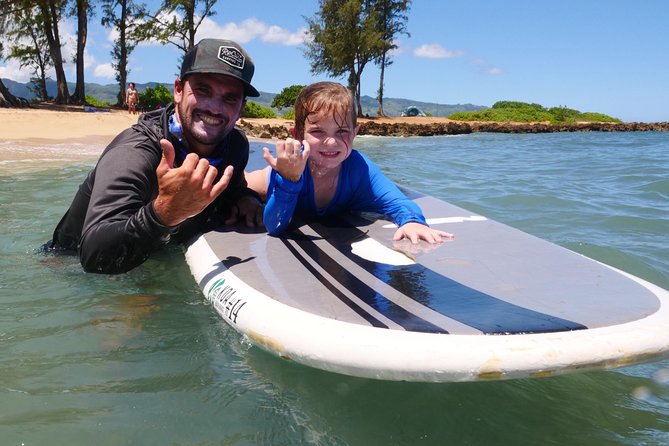
Hawaiian sea turtles are likely to appear during the lesson. Seeing one in the water can be a special part of your time on Oahu, especially when you are already focused on the waves and the unusual setting.
Treat this as a possible bonus, not a promised feature. Sea turtles are wild animals, and the lesson remains a surf lesson. The instructor’s main job is to help you surf safely and make good use of the conditions.
The chance of seeing turtles also gives the session a local connection beyond the mechanics of standing on a board. You are not just practicing an indoor skill at a resort pool. You are learning in the ocean, with the possibility of encountering one of Hawaii’s best-known marine animals.
Keep your attention on the water and follow the instructor’s directions around any wildlife. The information provided does not promise a specific turtle location or viewing time, so the experience will still be worthwhile if none appear.
Is $225 per person a fair price?
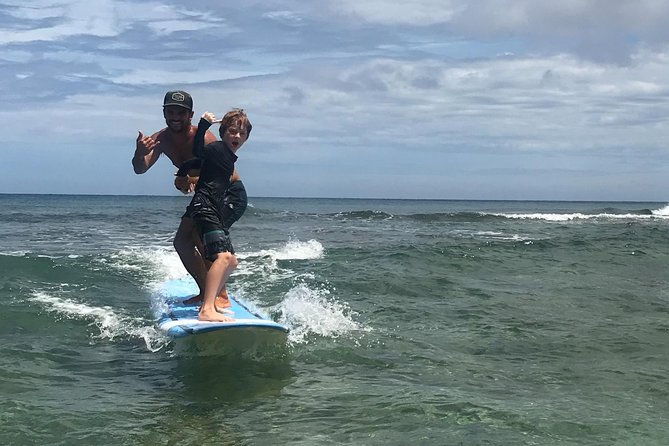
At $225 per person, this is not a budget surf lesson. For one person, the price may be hard to justify if you only want to try standing on a board once and do not care about private coaching. For a couple or small group, the cost buys more control over the pace and less time waiting for an instructor to rotate through a large class.
The included equipment helps. You do not pay the lesson fee and then add a separate board rental. You also receive two hours, which includes the land briefing and water practice. The instructor’s lifeguard and Red Cross CPR certifications add a useful safety standard, especially for families and first-timers.
The value improves if you have a clear goal. A beginner can use the private setting to build confidence. An improving surfer can ask for targeted advice. A family can keep the session together rather than splitting up among different classes.
The price is less attractive for a large group if everyone expects constant one-on-one coaching. Six people can take part, but the instructor’s attention will be shared. Before booking, think about how many people truly want to surf and what each person hopes to learn.
This activity is booked, on average, 53 days ahead. That does not mean every date requires that much planning, since one family managed to arrange a session within 45 minutes of calling. Still, popular dates can fill, and advance planning is wise if your schedule is fixed.
Who should book this lesson
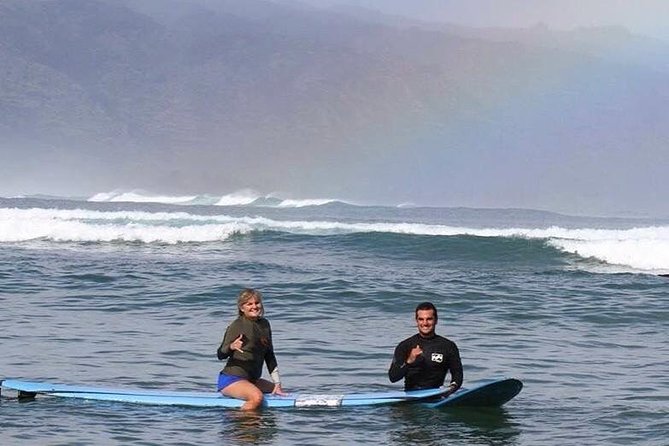
I would consider this a good match for:
- A first-time surfer who wants personal help instead of a large class
- A parent booking for a child or teenager
- A couple or family that wants a shared ocean activity
- An intermediate or advanced surfer looking for focused feedback
- A group that values a beach chosen around the day’s conditions
- Anyone who wants equipment included and a two-hour session
You may want to compare other options if the $225 price is beyond your budget, if you prefer a fixed beach confirmed far in advance, or if your group expects every person to have an instructor at all times.
The activity is offered in English. Mobile ticketing makes the booking easy to carry, and confirmation is provided at booking. Service animals are allowed, public transportation is nearby, and most people can participate. The information provided does not list specific physical restrictions, so contact the operator if someone in your group has an individual concern.
Free cancellation is available when you cancel at least 24 hours before the start time. Changes or cancellations made within 24 hours are not accepted for a refund, and the cutoff follows local Oahu time.
Should you book 808 Surf School?
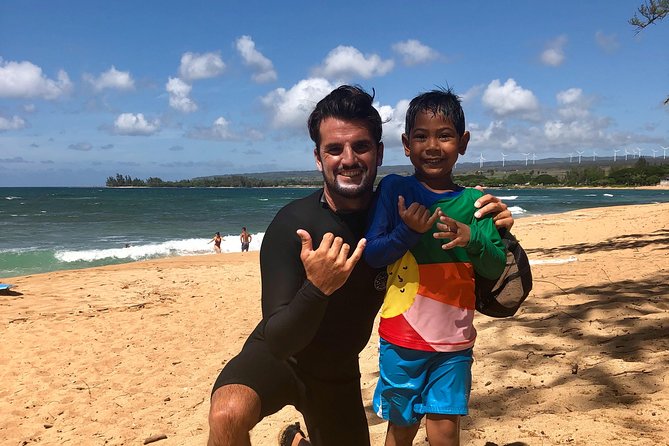
Book this private lesson if you want more than a quick board rental and are willing to pay for instruction tailored to your group. The strongest reasons are the two-hour format, included equipment, certified instructors, private setting, and the ability to adjust the beach to the ocean conditions.
I would especially choose it for a child, a first-timer who feels nervous, or an intermediate surfer who wants clear advice instead of general tips. Mike, Andy, and Jon have experience with a wide range of ages and abilities, and the teaching can move from basic balance to more advanced improvement.
Think twice if you are watching every dollar or if your group is large and expects nonstop individual attention. For everyone else, this offers a practical way to give surfing a fair try on Oahu, with a good chance of leaving the water having learned something real, not just posed on a board.
FAQ
Where does the private surf lesson meet?
The listed starting point is 53-360 Kamehameha Hwy, Hauula, HI 96717, USA.
Does the lesson always take place at the listed meeting point?
The exact lesson location is provided after booking according to the ocean conditions for that day.
How long does the surf lesson last?
The lesson lasts approximately two hours.
What happens at the start of the lesson?
You have a short meet and greet, followed by a 10 to 15 minute land briefing covering surfing basics and ocean safety.
Is equipment included?
Yes. All equipment needed for the surf lesson is included.
Is this a private activity?
Yes. Only your group participates in the activity.
Which language is the lesson offered in?
The lesson is offered in English.
Are instructors trained in safety?
The instructors are lifeguard and Red Cross CPR certified.
Could I see Hawaiian sea turtles?
You are likely to see Hawaiian sea turtles during the lesson, though a sighting is not guaranteed.
Can I cancel for a full refund?
Yes, if you cancel at least 24 hours before the experience start time. Cancellations within 24 hours are not refunded, and changes within that period are not accepted.
Newest Oahu write-ups
- West Oahu: Eco-Friendly Whale Watching Cruise★ 4.5 · 40 reviews
- Oahu: Waikiki Eco-Friendly Morning Whale Watching Cruise★ 4.4 · 119 reviews
- Oahu: Circle Island Tour with Lunch & Waimea Waterfall★ 4.4 · 134 reviews
- West O’ahu: Dolphin Watching and Snorkeling Catamaran Cruise★ 4.5 · 31 reviews
- West O’ahu: Swim with Dolphins Catamaran Cruise★ 4.9 · 70 reviews
- Oahu: Waimea Falls & valley & North Shore day★ 5.0 · 4 reviews
- Honolulu, Oahu: Waikiki Turtle Snorkel Tour w/Shuttle Option★ 3.6 · 81 reviews
- Waikiki: Surf Lessons Easy 60 min classes no crowds!★ 4.9 · 21 reviews
Oahu Surf Lessons, compared.
Beginner-Friendly Waikiki Beach Surfing Lesson
Read our review →
Family, Private & Group Surfing Lessons, Waikiki Courtesy Shuttle
Read our review →
Browse the lists this tour appears in