
Reviewed · OAHU FOOD TOURS
Hawaii Off The Beaten Path Food Tour
Oahu’s best food stories are often found away from the beach hotels. This tour leads you through Chinatown, downtown Honolulu, markets, and small local food stops for a generous spread of Filipino, Chinese, Japanese, Vietnamese, Korean, and Hawaiian tastes. Victor and TJ bring local context to each bite, from manapua to fatty tuna.
I like the sheer range of food and the chance to see where locals shop, not just where visitors are sent. I also like the friendly, flexible feel: the guides adjust the pace, explain unfamiliar foods, and provide containers when the portions become too much. The main drawback is simple: this is a standing and eating tour, and serious food allergies require advance planning.
Key points to know before booking
- Come very hungry: You may taste 15 to 17 substantial items, not tiny one-bite samples.
- Chinatown is the heart of the tour: Most of the food stops take place around local markets and small eateries.
- The menu crosses several cultures: Expect Filipino adobo and turon, Chinese roast meats, Japanese seafood, Vietnamese pandan cake, and Hawaiian poke.
- Victor and TJ add local context: They discuss Oahu’s multicultural food traditions and point out places you may not find on your own.
- Hotel pickup helps: Pickup and drop-off are available in Waikiki and Honolulu, usually between 9 and 9:30 a.m.
- The group is small, but confirm the size: The tour is described as small-group, with a listed maximum ranging from 12 to 16 people.
Why this Oahu food tour feels different
Many Honolulu food outings stay close to familiar tourist districts. This one takes you into downtown and Chinatown, where food is part of daily life rather than a polished show for visitors. You may pass fruit sellers, seafood counters, roast-meat shops, bakeries, and small restaurants serving food to local customers.
That setting matters. You are not only sampling dishes. You are seeing ingredients before they reach a plate, watching vendors serve regular customers, and learning how Hawaii’s food culture grew from many immigrant communities. Chinese, Japanese, Filipino, Korean, Vietnamese, and Hawaiian influences all appear on the table.
I especially like that the menu is not limited to one idea of Hawaiian food. Poke is here, of course, but so are Filipino braised chicken, banana lumpia, Chinese roast duck, Japanese sashimi, and tropical fruit. The result gives you a better sense of Honolulu than a meal built around one famous dish.
The guides are a major part of the experience. Victor is frequently named as the lead guide, while TJ sometimes joins him. Their role goes beyond carrying food from stop to stop. They explain what you are eating, answer questions about local culture, and introduce the people behind the counters. That personal connection is useful when you are trying foods you have never seen before.
More food tours in Oahu:
- Waikiki Trolley Blue Line Coastline & Local Grindz Hop-on Hop-off
★ 5.0 · 4,159 reviews - Sights & Bites Ultimate Oahu Circle Island Foodie Tour
★ 4.5 · 492 reviews - Hawaiian Food Tour by Bike in Oahu
★ 5.0 · 206 reviews
Starting at Izumo Taishakyo Mission of Hawaii
The morning begins at the Izumo Taishakyo Mission of Hawaii, an active Japanese Shinto temple beside Nuuanu Stream. You spend about 15 minutes here, with no admission charge.
This is a smart opening stop because it frames the food tour with a piece of Oahu’s Japanese heritage. The temple is more than a photo stop. It gives you a quick reminder that Honolulu’s culture was shaped by generations of immigration, faith, work, and family life.
The visit is brief, so do not expect a full temple tour. Its value is as an introduction before the food begins. If you meet the group here instead of using hotel pickup, this is also where the experience starts.
Manapua and the first taste of Chinatown
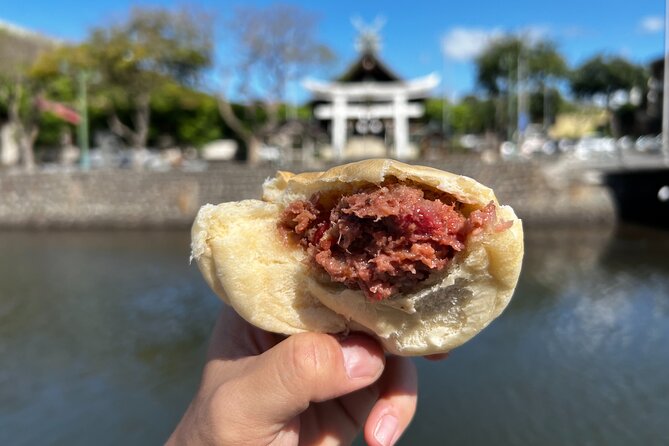
The first food is local manapua, a soft baked bun filled with savory, smoky pork. Think of it as a Hawaii-style cousin to a Chinese bao, though the baked sweet bread gives it a character of its own.
This is a good early stop because it is familiar enough to ease you into the morning but distinct enough to show how local food changes across cultures. The sweet bun and savory filling make it an easy favorite, but the portion is not necessarily a dainty starter.
Pacing matters from here. The tour may offer more food than you can finish at each stop, so take a sensible first portion if you want to try everything. Containers may be available for extras, which is helpful when the morning turns into several full meals.
Filipino flavors: chicken adobo and turon
The Filipino part of the tour includes chicken adobo, braised in a seasoned sauce, and turon, a fried banana dessert also known as banana lumpia. These dishes show two very different sides of Filipino cooking.
Adobo is savory, tender, and sauce-driven. Turon is crisp and sweet, with banana tucked inside a fried wrapper. Having the two together makes the stop more useful than tasting either one alone. You get a quick lesson in the balance of salty, tangy, rich, and sweet flavors common in Filipino food.
I like this section for people who want local food but may not know where to begin. These are recognizable, approachable dishes, yet they may be hard to find in the usual Waikiki dining circuit. The guides also connect the food to Hawaii’s larger multicultural story rather than presenting it as an isolated cuisine.
Same island, a completely different kind of day:
- Oahu Grand Circle Island and Haleiwa Tour: 9-Hr Deluxe Experience
★ 5.0 · 17,387 reviews - Oahu: Grand Tour Around Island 16 Locations plus Snorkeling
★ 5.0 · 8,669 reviews - Parasailing Experience in Waikiki, HI
★ 5.0 · 7,692 reviews - Salute to Pearl Harbor Including USS Arizona
★ 4.5 · 7,433 reviews
Tropical fruit at the market
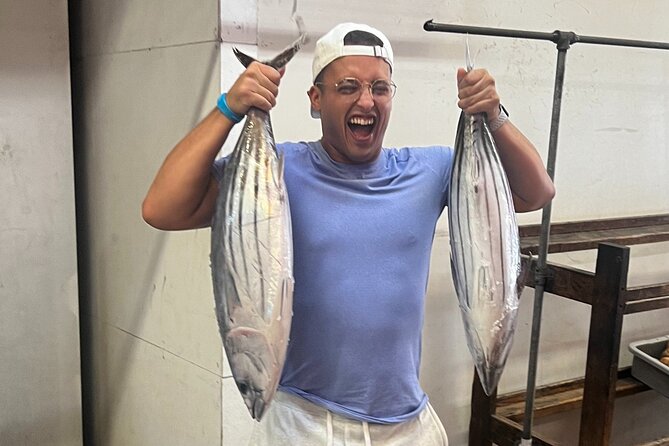
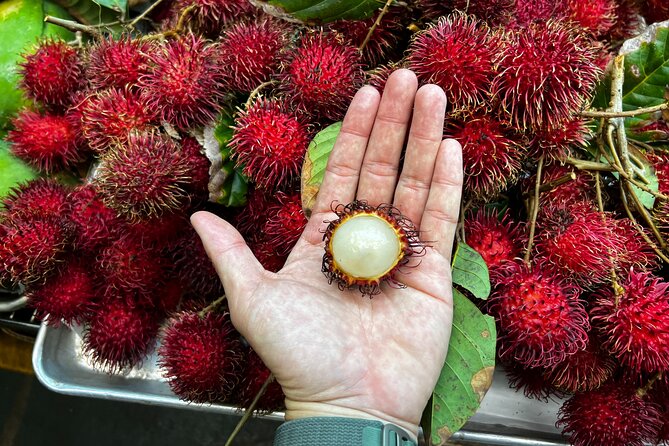
The fruit stop is one of the most distinctive parts of the morning. Depending on the season and what looks best that day, you may try five or more locally grown tropical fruits, with some sessions offering six or eight varieties.
The selection can include fruits that many mainland visitors have never tasted. The point is not only sweetness. Texture, smell, color, and preparation all change from fruit to fruit. Your guide can help you understand what is ripe, how the fruit is normally eaten, and why local markets are worth visiting.
This is also one place where the exact experience cannot be guaranteed. Fruit availability changes with the season, and the final selection depends on what is good at the market. That is a feature for flexible eaters, but it may disappoint anyone expecting a fixed menu.
If you are offered something unfamiliar, try a small piece first. You do not need to love every fruit to enjoy the stop. The fun is in finding one you would never have picked on your own.
Seafood from Japanese-style market counters
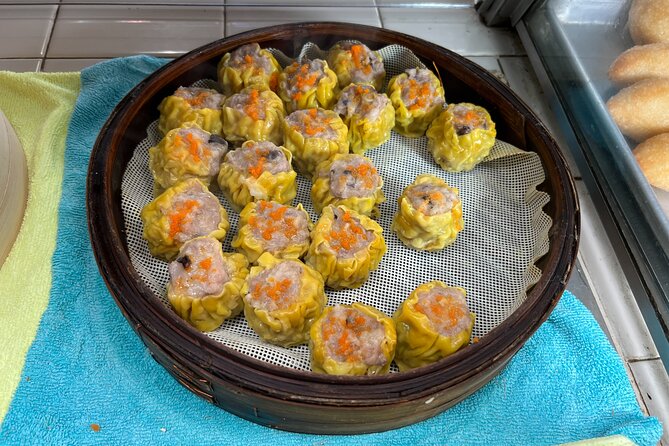
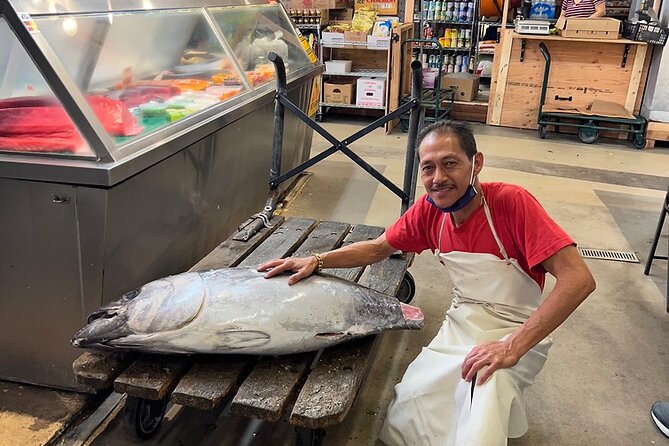
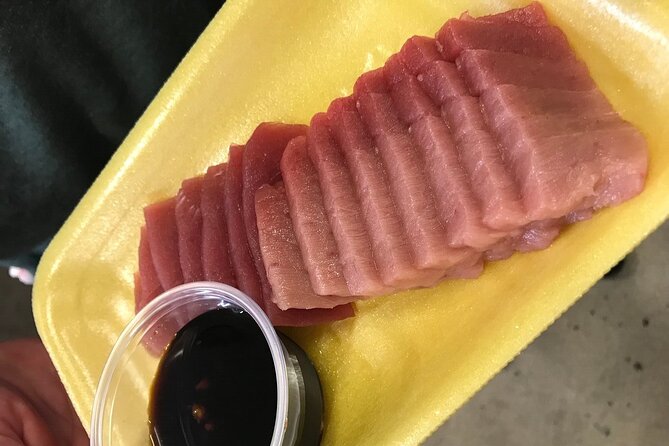
The seafood portion brings in fresh Japanese-style preparations, including chutoro sashimi and cooked Japanese octopus. Chutoro is fatty tuna belly, sliced and served raw. The octopus, or madako, is cooked and paired with a Korean-style spicy dressing and flying fish eggs.
This is the point where the tour becomes less suited to cautious eaters. The tuna is raw, and the quality of the seafood is central to the experience. If you already like sashimi and poke, this may be a highlight. If raw fish is new to you, the guide can explain the difference between the preparations and help you decide how much to try.
The stop depends on availability, so the exact seafood may change. That is normal for a market-based food tour. You are seeing what is fresh rather than receiving a fixed restaurant menu prepared weeks ahead.
I like the contrast between the rich, clean taste of chutoro and the spicy, seasoned octopus. It shows that seafood in Honolulu is not one single tradition. Japanese technique, Korean seasoning, and Hawaiian ingredients can all appear in the same meal.
Kauai prawns and the idea of local sourcing
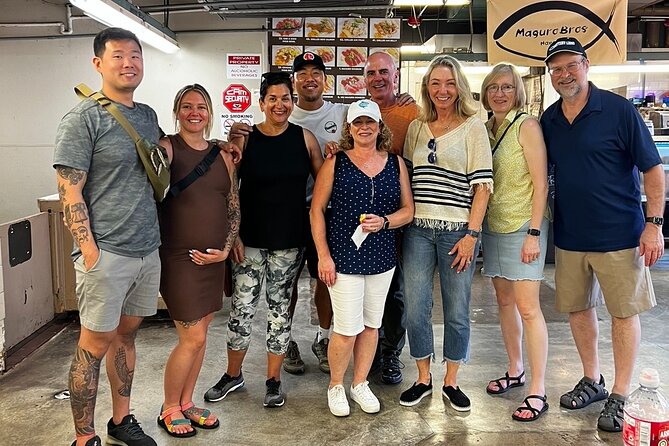
The tour also includes wild-caught deep-water prawns from Kauai, described as ama ebi or botan shrimp. These are valued for their sweet, delicate flavor and firm texture.
The prawns give the food lineup a more regional reach. Although the walking portion centers on Honolulu, the menu can introduce ingredients from other Hawaiian islands. This helps you think of Hawaii as a group of connected food communities rather than one uniform destination.
As with the market seafood, availability can affect what is served. If a particular item changes, the larger point remains: you are tasting fresh ingredients presented in Japanese-influenced ways.
Chinatown roast meats
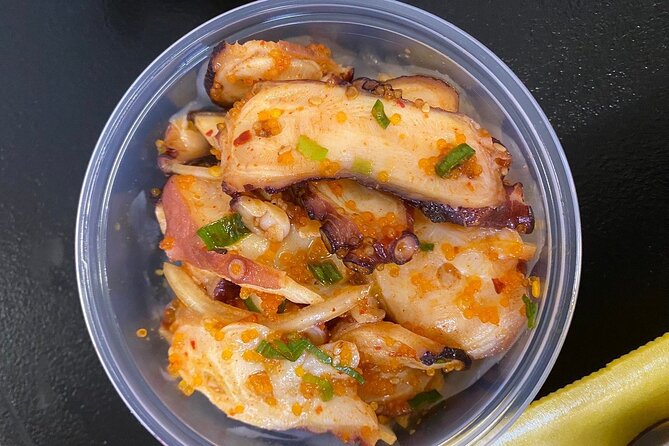
The roast-meat stop is one of the most filling parts of the tour. Depending on availability, you may try Chinese-style roast duck, crispy roast pork belly, and sweet honey barbecue pork, also called char siu.
This is not a quick nibble. The portions can be generous, and the combination of crisp skin, fatty pork, and sweet glaze adds serious weight to the morning. I would save room for this stop rather than treating it as a final extra.
The roast meats also give you a look at why Chinatown is such a useful place for a food tour. A market or shop specializing in roast meats can offer several preparations side by side, allowing you to compare texture and seasoning in one visit.
Some people will find this the easiest part of the menu. Others may prefer the lighter fruit and seafood. You do not need to rank the foods, but you should know that the morning is heavy as well as adventurous.
Poke in two different styles
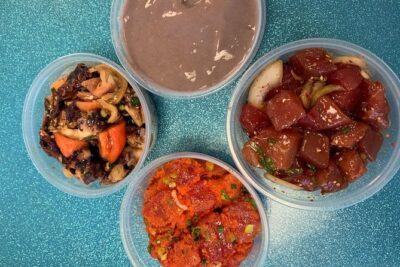
Poke appears in both spicy ahi and Hawaiian-style ahi limu versions. The fish is cut into cubes and seasoned rather than served as plain sashimi.
The Hawaiian-style preparation lets the fish remain central, with local seasoning and limu, or seaweed, adding flavor. The spicy ahi version brings more heat and intensity. Tasting both helps you understand why poke is not simply raw fish with a sauce poured over it.
This is a useful place to ask questions. Poke varies widely across Hawaii, and the seasoning can tell you a lot about the balance a shop prefers. A fresh fish market also gives the dish a different context than a prepared bowl from a hotel restaurant.
If you are unsure about raw fish, do not assume poke will taste like sushi. The cubes, seasoning, and other ingredients create a different experience. Still, raw tuna is a core part of this tour, so it is not the best pick for someone who avoids seafood.
Vietnamese pandan cake for a sweet finish
The final sweet is Vietnamese green pandan cake. Pandan gives the cake a fragrant, slightly grassy aroma and a vivid green color, while the texture is soft and springy.
It is a small but useful ending because the tour has already moved through several Asian food traditions. You finish with another example of how Honolulu’s food scene reflects the Pacific and Southeast Asia.
By this stage, you may be full enough to save the cake. That is not a problem. The food is served in enough volume that taking extras for later may be part of the practical plan.
Three hours, standing time, and transportation
The experience lasts about three hours and begins at 9:30 a.m. Hotel pickup usually takes place between 9 and 9:30 a.m., depending on traffic. Pickup and drop-off are offered in Waikiki and Honolulu, but not from Kailua, Kaneohe, Aulani, Ko Olina, or the Four Seasons area. Those staying outside the pickup zone meet the group at the first stop.
The tour begins at 201 N Kukui Street and returns to the meeting point. If your hotel or Airbnb does not appear during booking, you need to provide the accommodation details or contact the operator at least 24 hours before the start.
Most of the experience involves walking and standing. The route is described as manageable and on even pavement, but seating is arranged only when possible. Wear comfortable shoes, and do not plan a tight activity immediately afterward.
The listed group limit is small compared with a bus tour, though the information gives both 12 and 16 as maximum figures. If having the smallest possible group matters to you, confirm the current limit before booking.
Is the $150 price fair?
At $150 per person, this is not a cheap way to grab lunch. It is a guided morning with transportation, cultural explanation, market access, and a large amount of food.
The value improves if you use the tour as a first-day orientation to Honolulu’s food scene. You are paying to find places that can be difficult to locate, taste many dishes without ordering full portions at each stop, and learn what to look for later in your trip. The hotel pickup also saves you the trouble of arranging transport to Chinatown.
The food quantity is unusually high for a three-hour tasting tour. You may receive enough to share or take away, rather than a series of tiny samples. That makes the price easier to justify for people who enjoy seafood, meat, fruit, and sweets and would otherwise spend a similar amount on several meals.
It is less valuable if you are a very selective eater, avoid raw fish, or want a relaxed seated meal. You may also find the food too plentiful, though containers can help turn leftovers into a later snack.
Who should book this food walk?
I would choose this tour early in an Oahu stay if I wanted help finding local food beyond Waikiki. It suits curious eaters who like trying unfamiliar fruit, seafood, and dishes from several cultures in one morning.
It is also a good fit for families and mixed-age groups if everyone can manage standing and walking. The guides have adjusted the pace for older participants, and the route is described as easy on even pavement. Still, the food itself is adventurous, so each person should be comfortable with the possibility of raw tuna and unfamiliar ingredients.
I would skip it if you need a fully seated experience, have serious food allergies that have not been discussed in advance, or want a fixed menu with no substitutions. Contact the operator before booking if allergies are a serious concern.
Free cancellation is available up to 24 hours before the start time. Poor weather may lead to a new date or a full refund, while late cancellations are not refunded.
Should you book the Hawaii Off The Beaten Path Food Tour?
Book it if you want a generous, culture-focused introduction to Honolulu’s local food scene and you are willing to eat well beyond the familiar. The strongest reasons are the variety, the market setting, and the personal guidance from Victor, TJ, and the other local hosts.
Bring an empty stomach, comfortable shoes, and an open mind. If you do, the $150 price can buy more than breakfast. It can show you how Oahu’s many communities meet on the plate, then send you home with new cravings and enough leftovers for later.
FAQ
Where does the tour begin?
The listed meeting point is 201 N Kukui Street in Honolulu, Hawaii.
What time does the tour start?
The tour starts at 9:30 a.m. Hotel pickup generally takes place between 9 and 9:30 a.m., depending on traffic.
Is hotel pickup available?
Yes. Pickup and drop-off are available for hotels and Airbnb residences in the Honolulu and Waikiki areas.
Which areas are outside the pickup zone?
Pickup is not offered from Kailua, Kaneohe, Aulani, Ko Olina, or the Four Seasons area. You must meet the group at the first stop if you are staying in those areas.
How long does the tour last?
The experience lasts approximately three hours.
What foods are included?
Included tastings may include manapua, chicken adobo, turon, tropical fruit, Kauai prawns, chutoro sashimi, spicy ahi poke, Japanese octopus, roast duck, roast pork belly, char siu, Vietnamese pandan cake, and Hawaiian-style ahi limu poke.
Are drinks included?
Yes. You can receive local juice such as lilikoi, lychee, guava, or pineapple, or bottled water.
Is raw seafood served?
Yes. Chutoro sashimi and Hawaiian-style poke are included. The seafood selection can depend on availability.
Is the tour suitable for people with serious food allergies?
Serious food allergies should be discussed with the operator before booking.
Can I cancel for a refund?
You can cancel at least 24 hours before the start time for a full refund. Cancellations or changes made less than 24 hours in advance are not refunded.
What happens if the weather is poor?
If the tour is canceled because of poor weather, you are offered a different date or a full refund.
Newest Oahu write-ups
- Private Surf Lessons in Honolulu★ 5.0 · 76 reviews
- Private Round-Trip Transfer: Honolulu International Airport to Hotel or Cruise Terminal★ 4.0 · 34 reviews
- Private Pearl Harbor USS Arizona Memorial★ 4.5 · 3 reviews
- Private Pearl Harbor and Mini Circle Island Tour from Waikiki★ 5.0 · 8 reviews
- Passport to Pearl Harbor “Private”★ 5.0 · 4 reviews
- Pearl Harbor USS Arizona and USS Missouri “Private”★ 5.0 · 10 reviews
- Private Tour Oahu – up to 6 passengers – Customizable★ 5.0 · 3 reviews
- Private One-way Airport Transfer Honolulu Airport To Honolulu★ 4.0 · 24 reviews
Oahu Food Tours, compared.
Waikiki Trolley Blue Line Coastline & Local Grindz Hop-on Hop-off
Read our review →

Oahu Sights and Bites Circle Island Foodie Tour
Read our review →
Downtown Honolulu Food Tour with 5 Local Favorites Tastings
Read our review →
Diamond Head Sunrise Hike with Acai Bowl and Malasada
Read our review →Browse the lists this tour appears in