Reviewed · PRIVATE
Private Efoil Experience in Ke’ehi Lagoon
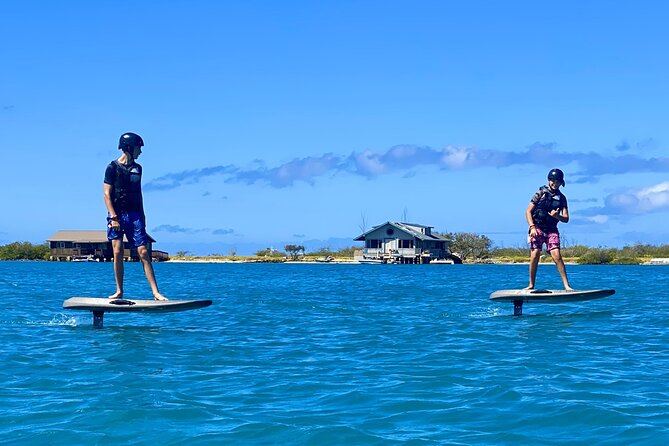
An electric hydrofoil board lets you rise above the water on a small underwater wing, turning a regular surf session into something closer to silent flight. You begin with a safety lesson and balance-board practice, then work through belly riding, kneeling, standing, and controlled lift with a remote in your hand. Ben and Jason are the named instructors, and helmet radios help you hear coaching once you move away from shore.
I especially like the step-by-step teaching plan and the fact that you do not need surf experience. I also like the protected-feeling progression: first learn the controls on land, then take three short water runs instead of being sent out for one long, tiring attempt. The main consideration is the limited water time: each student gets about 30 minutes on the water, and one eFoil is shared by two students.
Key points to know before booking
- Three ten-minute water runs: Each student gets about 30 minutes of water time, split into manageable sessions.
- A real beginner progression: You practice belly riding, knee riding, standing, and controlled lift in that order.
- One board for two students: The lesson requires at least two students, so you take turns rather than riding continuously.
- No surf background required: Balance from skateboarding, wakeboarding, kneeboarding, or similar sports may help.
- Helmet radios aid instruction: You can hear coaching while moving away from the guide.
- Extra charges matter: Photos cost $39, and students over 205 pounds pay a $49 Big and Tall charge.
Flying above the water instead of paddling through it
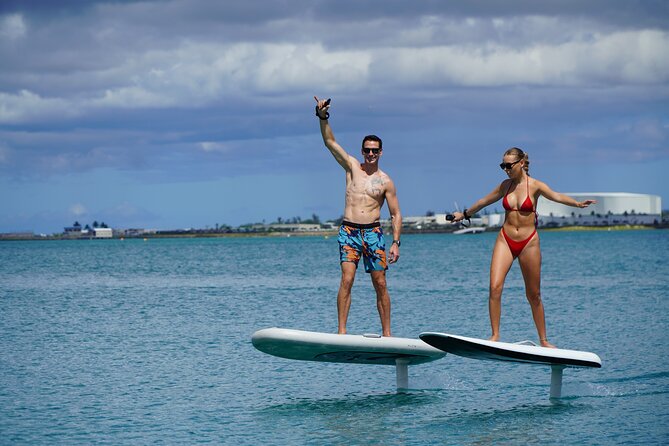
An eFoil is a battery-powered board with a motor, hand remote, and hydrofoil. At low speed, it moves like a powered surfboard. As you gain speed and shift your weight correctly, the underwater foil lifts the board above the surface.
That change is the whole appeal. You are not waiting for a wave or paddling hard to catch one. You learn to control your speed with the remote and your direction with body position. Once the board rises, the water becomes quieter beneath you and the ride feels less like surfing and more like controlled flight.
I would not treat this as a casual float or a sightseeing cruise. You are learning a new balance skill, and you should expect falls while you find the correct position. The good news is that the lesson is built for first-timers, with clear stages that let you progress at your own speed.
The advertised age minimum is 13. No surf experience is needed, but board-sport balance can shorten the learning curve. If you have skateboarded, wakeboarded, kneeboarded, or done something similar, you may recognize the need to keep your weight centered and make small adjustments instead of sudden ones.
A few more Oahu trips worth putting side by side
- Turtle Canyon Snorkel: Semi Private Boat Tour
★ 5.0 · 710 reviews - Honolulu Airport, Cruise Port and Hotels Private Transfer
★ 5.0 · 452 reviews - Honolulu Airport: Waikiki Private Transfer With Lei Greeting
★ 5.0 · 339 reviews
The first 15 to 30 minutes: safety and the eFoil simulator
The lesson begins on land with a comprehension lesson and safety class. That part deserves your full attention. The remote controls the motor, while your body position controls the board, and you need to understand both before heading onto the water.
You then use a balance board called the eFoil Simulator. It lets you practice center-of-gravity control without also dealing with water, speed, and a moving board. The instructor introduces three positions: belly down, kneeling, and standing.
This is a smart use of the opening time. You can concentrate on how the board reacts to small movements before adding the motor. The simulator will not reproduce every part of the real ride, but it gives you a basic sense of where your weight belongs and how the transitions work.
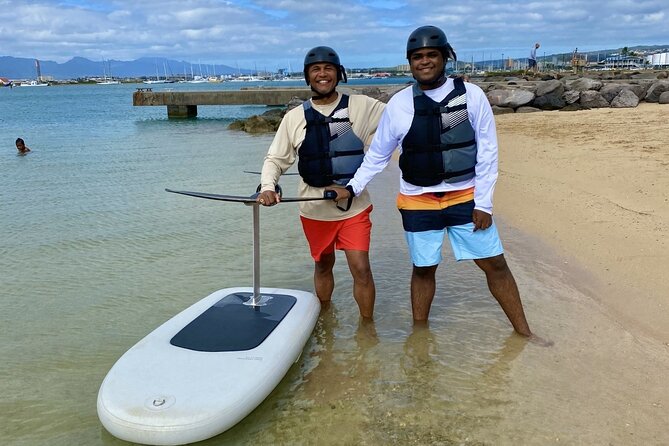
Safety equipment and a certified guide are included. Helmet radios are also used, giving you a way to hear instructions as you move farther from the instructor. That matters because shouted advice becomes less useful once the board is humming across open water.
The first water run: belly riding and remote control
Your water time is split into three ten-minute runs per student. The first run starts with belly rides. At this stage, you are learning how the board moves and how to use the remote without worrying about standing.
You practice turning the board and managing the motor. This may sound simple, but it is the foundation for everything that follows. If your speed or direction is wrong while kneeling or standing, you will have fewer options to correct yourself.
The short run format works in your favor. Ten minutes is long enough to focus, but short enough to regroup, listen to feedback, and let the other student ride. It also reduces the chance that a beginner burns through all their energy before learning the more exciting positions.
The tradeoff is clear: the experience lasts about two hours, but only about 30 minutes per student is actual water time. The remaining time is used for instruction, safety, setup, observation, and switching. If you are expecting two hours of continuous riding, this is not that kind of booking.
The second run: knees, touch and go foiling
Once you are comfortable belly riding, the instructor moves you into a kneeling position. The lesson then introduces touch and go foiling, where the board begins to lift and settle back down.
This stage is where the eFoil starts to make sense. You learn that standing up is not the first goal. First, you need to feel how much pressure and speed bring the foil toward the surface, then learn to manage the board when it briefly rises.
Kneeling gives you a lower center of gravity and makes it easier to recover. You can work on balance without having to control your full standing posture at the same time. The instructor can adjust the pace based on how quickly you respond.
Many beginners are able to stand or get the board airborne during a first lesson, but you should not book on the assumption that you will master long flights. The provider says most students become confident within 30 to 60 minutes of lessons, yet your result depends on balance, comfort, and how quickly you absorb the controls.
Same island, a completely different kind of day:
- Oahu Grand Circle Island and Haleiwa Tour: 9-Hr Deluxe Experience
★ 5.0 · 17,387 reviews - Oahu: Grand Tour Around Island 16 Locations plus Snorkeling
★ 5.0 · 8,669 reviews - Parasailing Experience in Waikiki, HI
★ 5.0 · 7,692 reviews - Salute to Pearl Harbor Including USS Arizona
★ 4.5 · 7,433 reviews
The third run: standing, e-surfing, and lift
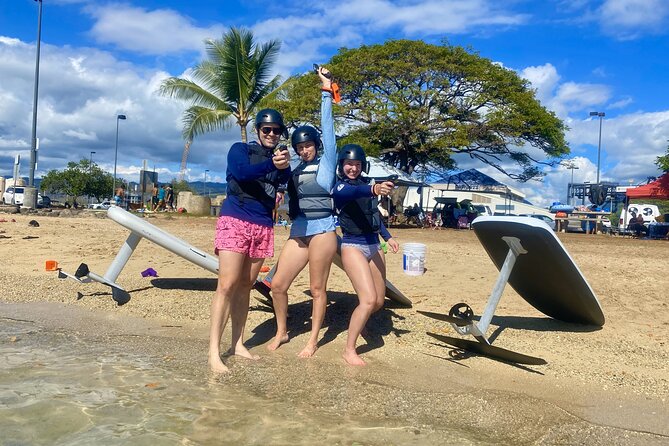
The next step is a pop-up to standing. You begin with e-surfing, which means riding the powered board on the surface while mastering turns and body position.
Only after that do you work on slowly rising out of the water into the eFoiling position. This order is important. Standing on the board is not the same as flying above the water. You need to keep your weight controlled, maintain a steady line, and avoid making large movements when the foil begins to lift.
The instructor then works with you on touch and go foiling before moving toward sustained rides. If you find the sweet spot, the board can glide above the water for longer stretches. That is the moment most people are chasing, and it is also where patience pays off.
The strongest teaching detail here is the insistence on learning at your own speed. A good first session may mean only brief lift, while another student might manage a longer flight. The lesson is more useful when you treat each stage as progress rather than comparing your result with someone else in the group.
Ben, Jason, and the value of direct coaching
Ben is the instructor most closely associated with the experience, and the supplied feedback repeatedly points to his clear, patient teaching. He is described as efficient with instructions, careful about safety, and good at giving useful tips while the board is moving.
Jason is also named as an instructor and has helped with equipment and sessions. You may be working with Ben, Jason, or both, depending on the booking.
The helmet radios are a practical feature, not a fancy extra. An instructor can give a short correction while you are riding rather than waiting for you to return to shore. Small changes in weight or posture are easier to understand when the advice arrives at the right moment.
I also like that the teaching does not assume surfing experience. You are not expected to know how to catch waves, paddle into position, or read a surf break. The focus is on balance, motor control, turns, and a gradual rise above the water.
Keʻehi Lagoon setting and meeting details
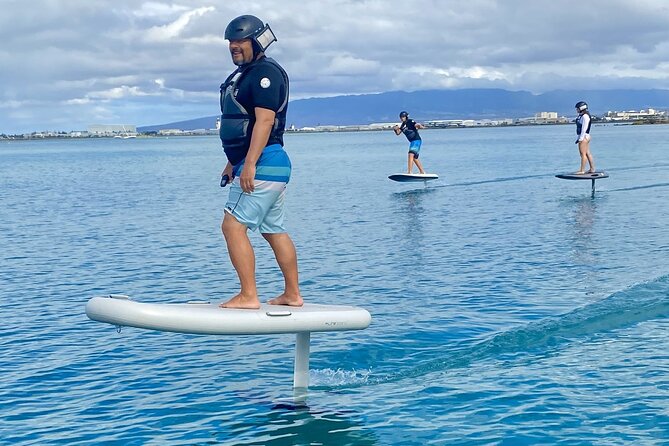
The experience is presented as a Keʻehi Lagoon activity, while the stated meeting point is Hawaii Efoil Experience at 1216 Akumu Street in Kailua, Hawaii. The activity ends back at the meeting point.
Because the supplied information names both Keʻehi Lagoon and a Kailua meeting address, confirm the exact water access and arrival instructions when you book. Private transportation is not included, so you are responsible for reaching the meeting point.
The setting is described as safe and beautiful, and one session is specifically associated with smooth water near Sand Island. Calm water is valuable for a beginner because you can focus on the board instead of handling large chop. Conditions still depend on weather, and the operator can cancel for poor weather.
Public transportation is nearby, and service animals are allowed. Most people can participate, but the activity requires active balance and control. The minimum age is 13, and the lesson is not designed as a passive ride for someone who does not want to fall or practice.
Why one eFoil for two students changes the experience
This is a group lesson with a minimum of two students and one eFoil per two students. In practical terms, you take turns riding while the other person listens, watches, and prepares for the next attempt.
That arrangement makes the $188 price easier to understand, but it also sets limits. You are paying for the guide, safety instruction, equipment, simulator practice, and coaching, not two hours of uninterrupted board time. If you and a partner are both beginners, the shared format can work well because you learn together and see the correct body positions before your next turn.
If you want a more tailored arrangement, you can call about adding students for a customized semi-private lesson. The available information does not promise a particular board-to-person ratio beyond the stated one eFoil per two students, so ask about the format before paying if individual riding time is your main concern.
Is $188 a fair price?
At $188, this is not a cheap add-on activity. Its value depends on what you want from your time on Oahu.
The price includes safety equipment, a certified guide, land instruction, simulator practice, and about 30 minutes of water time for each student. You are also getting a structured introduction to equipment that would be difficult to learn safely by trial and error.
I see the price as reasonable for a focused first lesson, especially if flying above the water is high on your list. I would be less enthusiastic if you want a long, relaxed water session or if you already own an eFoil and simply want to ride without instruction.
Two additional costs are easy to miss. Photos are available for $39, and students over 205 pounds pay a $49 Big and Tall charge. Those charges can change the total, so include them in your budget before booking.
Who will enjoy this most
This suits you best if you like learning physical skills and want something different from standard surfing. It is a good choice for families with teenagers age 13 and up, couples who want to share a new activity, and people with some board-sport balance.
It also works for beginners who have never surfed. The powered board removes the need to catch a wave, and the progression lets you start on your stomach rather than trying to stand at once.
You should think twice if you dislike falling, have limited mobility, or want a purely scenic water outing. The activity is active and instructional. You will spend time listening, practicing, taking turns, and trying again.
Experienced eFoil riders can still use the service to arrange a session while visiting Oahu, but the main value is instruction. If you already know how to ride, ask about supervised time or a format that gives you more freedom.
Weather, cancellations, and final booking advice
You can cancel for a full refund up to 24 hours before the local start time. Cancellations within 24 hours are not refunded, and changes during that window are not accepted.
Weather matters. If poor conditions force a cancellation, you are offered another date or a full refund. That policy is useful for a water activity, but it means you should avoid booking this as the one fixed event around which your entire Oahu schedule depends.
I would book it if you want a memorable, hands-on challenge and are comfortable with limited riding time in exchange for close instruction. I would skip it if your priority is continuous board time or a quiet sightseeing trip.
For the best chance of enjoying the session, arrive ready to listen, keep your expectations flexible, and treat the first lesson as a progression rather than a test. The thrill is not only in getting airborne. It is in feeling the board rise because you finally made the right small adjustment.
FAQ
Where does the eFoil lesson meet?
The stated meeting point is Hawaii Efoil Experience, 1216 Akumu Street, Kailua, HI 96734, USA.
Where does the activity end?
The activity ends back at the meeting point.
How long does the experience last?
The experience lasts approximately two hours.
How much water time does each student receive?
Each student receives about 30 minutes of water time, split into three ten-minute runs.
How many students are needed to book?
A minimum of two students is required to book the group lesson.
How many eFoils are provided?
The lesson includes one eFoil for every two students.
Do I need surf experience?
No. Surf experience is not required, although balance from skateboarding, wakeboarding, kneeboarding, or another board sport may help.
What age must students be?
Students must be at least 13 years old.
Is safety equipment included?
Yes. Safety equipment and a certified guide are included.
What happens if poor weather cancels the lesson?
You will be offered a different date or a full refund if the activity is canceled because of poor weather.
Newest Oahu write-ups
- West Oahu: Eco-Friendly Whale Watching Cruise★ 4.5 · 40 reviews
- Oahu: Waikiki Eco-Friendly Morning Whale Watching Cruise★ 4.4 · 119 reviews
- Oahu: Circle Island Tour with Lunch & Waimea Waterfall★ 4.4 · 134 reviews
- West O’ahu: Dolphin Watching and Snorkeling Catamaran Cruise★ 4.5 · 31 reviews
- West O’ahu: Swim with Dolphins Catamaran Cruise★ 4.9 · 70 reviews
- Oahu: Waimea Falls & valley & North Shore day★ 5.0 · 4 reviews
- Honolulu, Oahu: Waikiki Turtle Snorkel Tour w/Shuttle Option★ 3.6 · 81 reviews
- Waikiki: Surf Lessons Easy 60 min classes no crowds!★ 4.9 · 21 reviews
Private, compared.

Honolulu Airport, Cruise Port and Hotels Private Transfer
Read our review →
Honolulu Airport: Waikiki Private Transfer With Lei Greeting
Read our review →

Private Customizable Grand Circle Island Tour of Oahu
Read our review →
Family, Private & Group Surfing Lessons, Waikiki Courtesy Shuttle
Read our review →